// blog › kubernetes
KUBERNETES · USING ARCHHY
Multi-cluster Kubernetes: prompt an overview readers can follow
On this page
- Use representative application groups instead of every pod.
- Keep global routing and management outside the regional workload boundaries.
- State replication and failover policy need their own explicit assumptions.
A Kubernetes multi-cluster diagram can become unreadable before it explains anything. This example stays at the regional overview level: traffic selection, two independent clusters, management and application state replication.
Part 9 of our Kubernetes prompting series. The diagram below is an authored Archhy example of the brief, not a claimed output from a particular AI model. Open it in the editor to inspect and adapt the native objects.
The prompt
Create an overview of two independent clusters, europe and americas. An external global traffic service uses health and latency to select a regional endpoint. Each cluster contains one representative application group. Show Argo CD in a separate management boundary reconciling both APIs. Draw asynchronous application-level state replication between regional data services. Mark conflict handling and failover policy as unresolved. Omit individual pods and intra-cluster networking.
On a computer, use AI → Generate with AI, Cloud: Auto, then Generate and Save. On a phone, AI → Generate applies the result with Undo available. Keep a copy of existing work before generating. Use an available configured model; results need inspection and may differ from this authored example.
Follow a regional request
A client reaches an external global traffic service. Health and latency select a regional endpoint for europe or americas. Each endpoint leads to the representative application in that cluster. The diagram leaves open whether the global service acts through DNS or proxy forwarding; choose and relabel that mechanism for your actual product. The logical traffic-selection arrows do not imply a universal physical packet path.
Keep management independent
Argo CD appears in a separate management boundary and reconciles both cluster APIs. Its dashed arrows stay away from the request path. This placement prevents the diagram from implying that one application cluster secretly hosts every management dependency. It still does not prove management availability; the actual deployment, credentials and failure behaviour need a separate review.
Make replication a separate conversation
Each regional application connects to its regional data service outside the cluster. The example draws illustrative asynchronous replication from europe to americas and labels that assumption directly. It does not invent an active-active write model. Conflict handling, write ownership and failover remain unresolved notes. Change the arrow only when the application design provides an answer; two cluster boxes alone do not establish consistency.
Stop before adding every mesh component
This overview deliberately omits service-mesh control planes and east-west gateways. If a mesh is deployed, create a second view stating its actual deployment and network model. Do not add a bidirectional line called mesh and treat it as proof of cross-cluster reachability or database replication. A regional detail view can then explain namespaces and workloads without overloading the global story.
An overview also needs an explicit failure question. Ask what users see when one regional endpoint becomes unhealthy and what data is available after selection changes. Leave the answers unresolved until the real routing and state design supplies them. A second healthy cluster is not sufficient evidence that every application operation can fail over safely.
Check the result
- Clusters remain independent containers with explicit external data services.
- The global selection mechanism is identified as logical or replaced with the actual product behaviour.
- The replication direction is labelled as an example assumption, not inferred from a mesh.
Inspect every arrowhead at both canvas and exported size. Solid blue rails show the operation named by their labels; dashed purple rails show management or configuration. Other colours are explained by the diagram legend. A rail describes a logical relationship, not necessarily a literal network hop.
Try one precise edit
Keep the overview. Mark europe to americas replication as an illustrative assumption and add questions for write ownership and failover. Do not invent reverse replication.
Use Edit with AI with Preserve layout on. Check the result against the previous diagram, undo if needed, then save the native version you want to keep. The diagram is an explanation aid, not executable configuration or a deployment check.
Continue the series
All ten prompts and the prompting method. Previous: External Secrets: prompt secret delivery without exposing values. Next: Knative Serving: prompt warm requests and cold starts.
Frequently asked questions
Should I draw every pod in both clusters?
Usually not in an overview. Use application groups and link to a separate regional detail view.
Does a service mesh replicate application state?
No. State consistency and replication need their own application or data-service design.
based on Original Archhy teaching example, informed by official istio.io documentation, Argo CD documentation. The example assumptions are named in the article and diagram; it is not a reproduction of a reference deployment.
more on kubernetes
How to prompt archhy: 10 Kubernetes diagram examplesWrite clearer architecture briefs in archhy, then try ten original Kubernetes prompts covering traffic, scaling, GitOps, storage and multi-cluster views.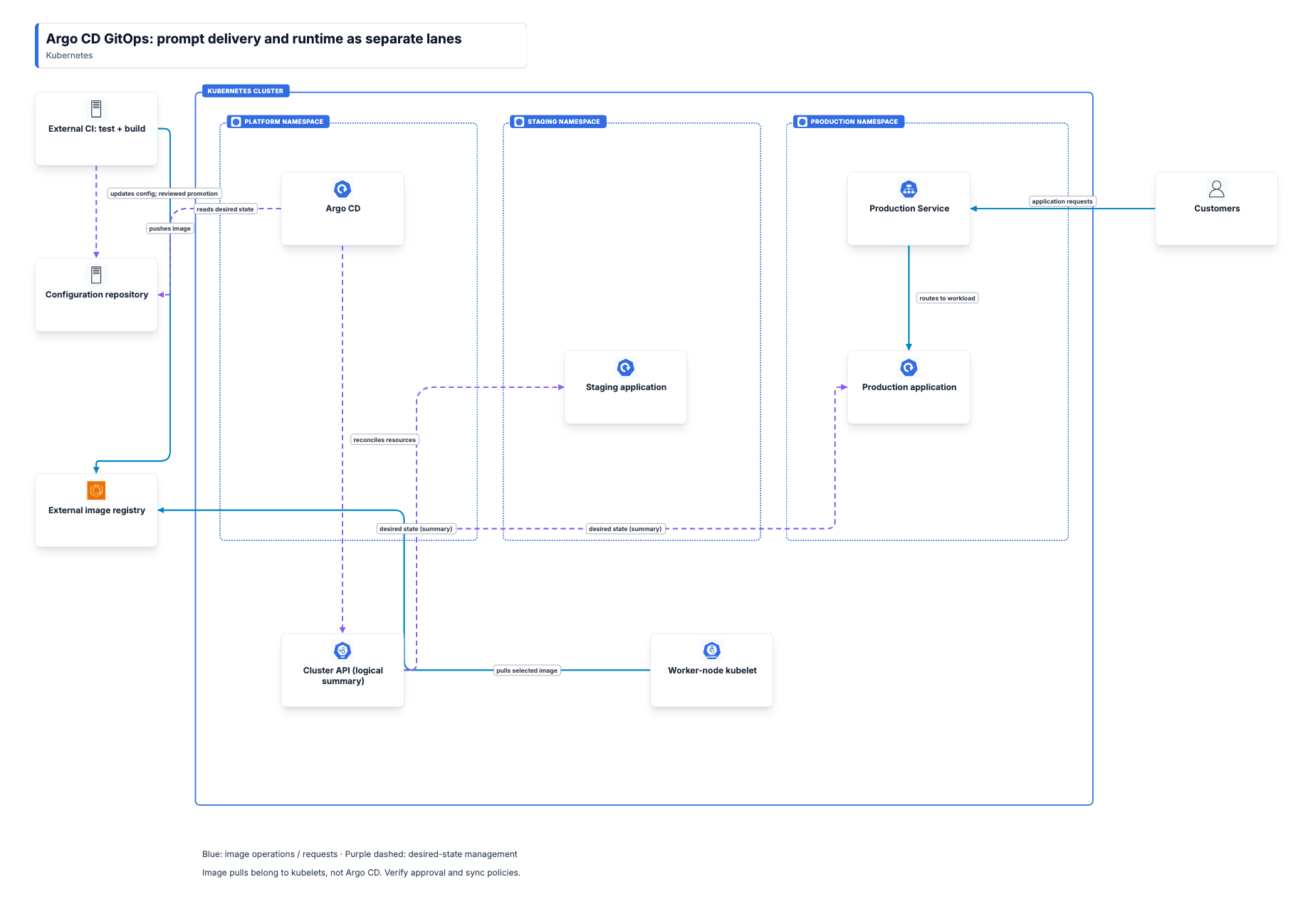 Argo CD GitOps: prompt delivery and runtime as separate lanesAn Argo CD GitOps diagram should show how desired state reaches the cluster while keeping customer traffic separate. This example draws a short delivery chain and makes production promotion a repository change that a reviewer can identify.
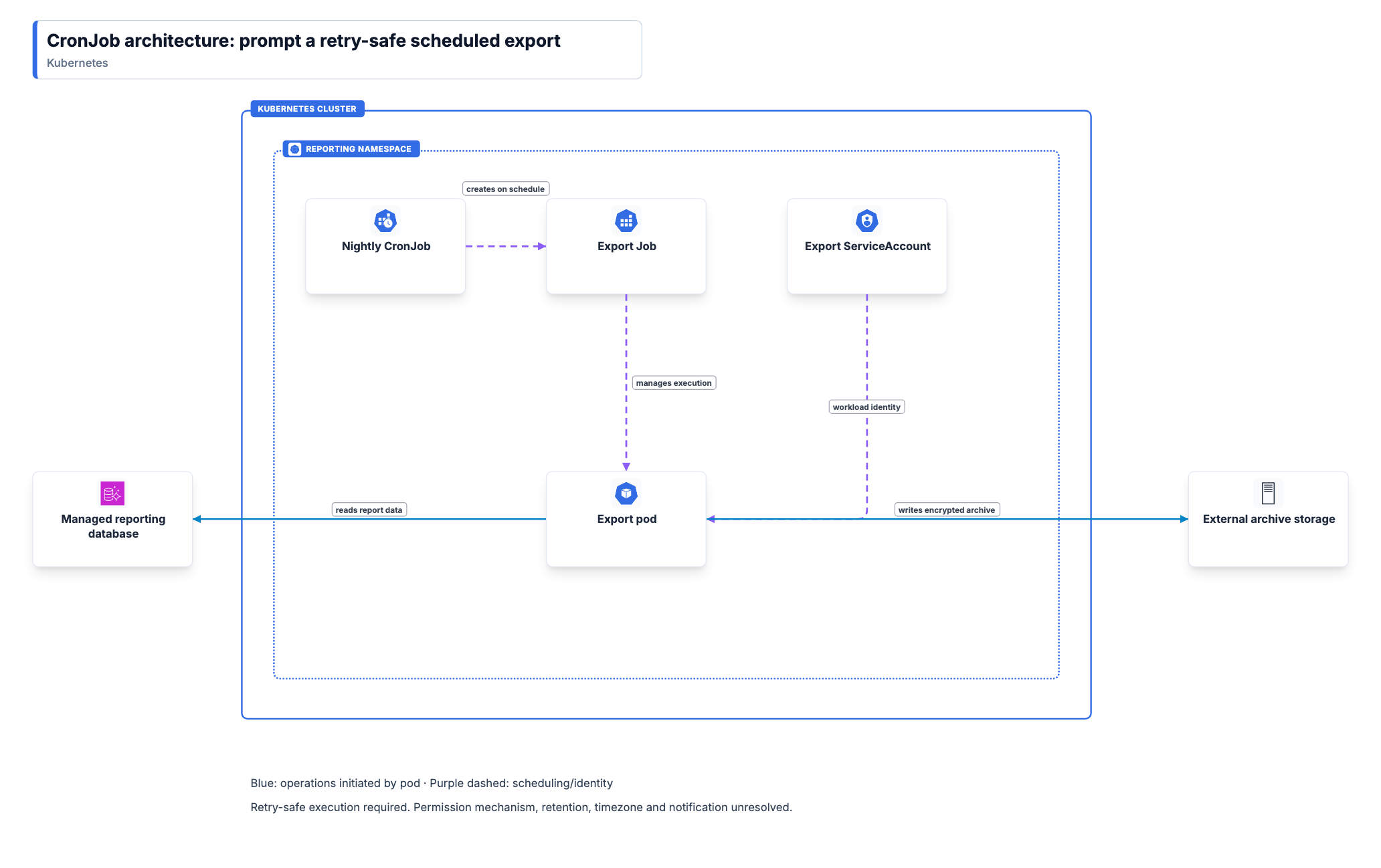 CronJob architecture: prompt a retry-safe scheduled exportA Kubernetes CronJob diagram can explain more than a clock pointing at a pod. This example follows a reporting export from its schedule to an archive, while showing where permissions and recovery assumptions belong.