Data lake, data warehouse and lakehouse on AWS
S3, Glue and Athena vs Amazon Redshift vs Apache Iceberg tables under one catalogue: what each is on AWS, where each fits in one diagram, and which to start with.
Opens a copy in the editor, in a new tab, ready to change. No account needed.
What’s in this diagram
services and parts
- Files, logs and events
- Aurora (operational database)
- Analysts, engineers, data scientists
- General purpose S3 bucket (raw files)
- S3 Tables (managed Apache Iceberg)
- Amazon Redshift (fast SQL)
- Glue Data Catalog (Iceberg REST)
- Lake Formation (fine-grained grants)
- Athena (SQL, pay per scan)
- EMR and Glue (Apache Spark)
- SageMaker Unified Studio
groups
- AWS Cloud
- Region
- Data lake: S3, open files
- Data warehouse
- Lakehouse layer: one catalogue, one set of grants
- Engines
- Workspace
Key points
- A data lake is open files in S3 with a catalogue, readable by many engines. A data warehouse is Redshift: its own storage, tuned for fast, concurrent SQL.
- A lakehouse gives lake files table behaviour with Apache Iceberg: transactions, updates and deletes, schema evolution, time travel.
- On AWS, the lakehouse is one catalogue and one set of Lake Formation grants across S3, S3 Tables and Redshift.
- It is rarely either/or. Most teams keep the lake for breadth and the warehouse for their busiest dashboards.
The whole story, step by step: Data lake vs data warehouse vs lakehouse on AWS.
More diagrams
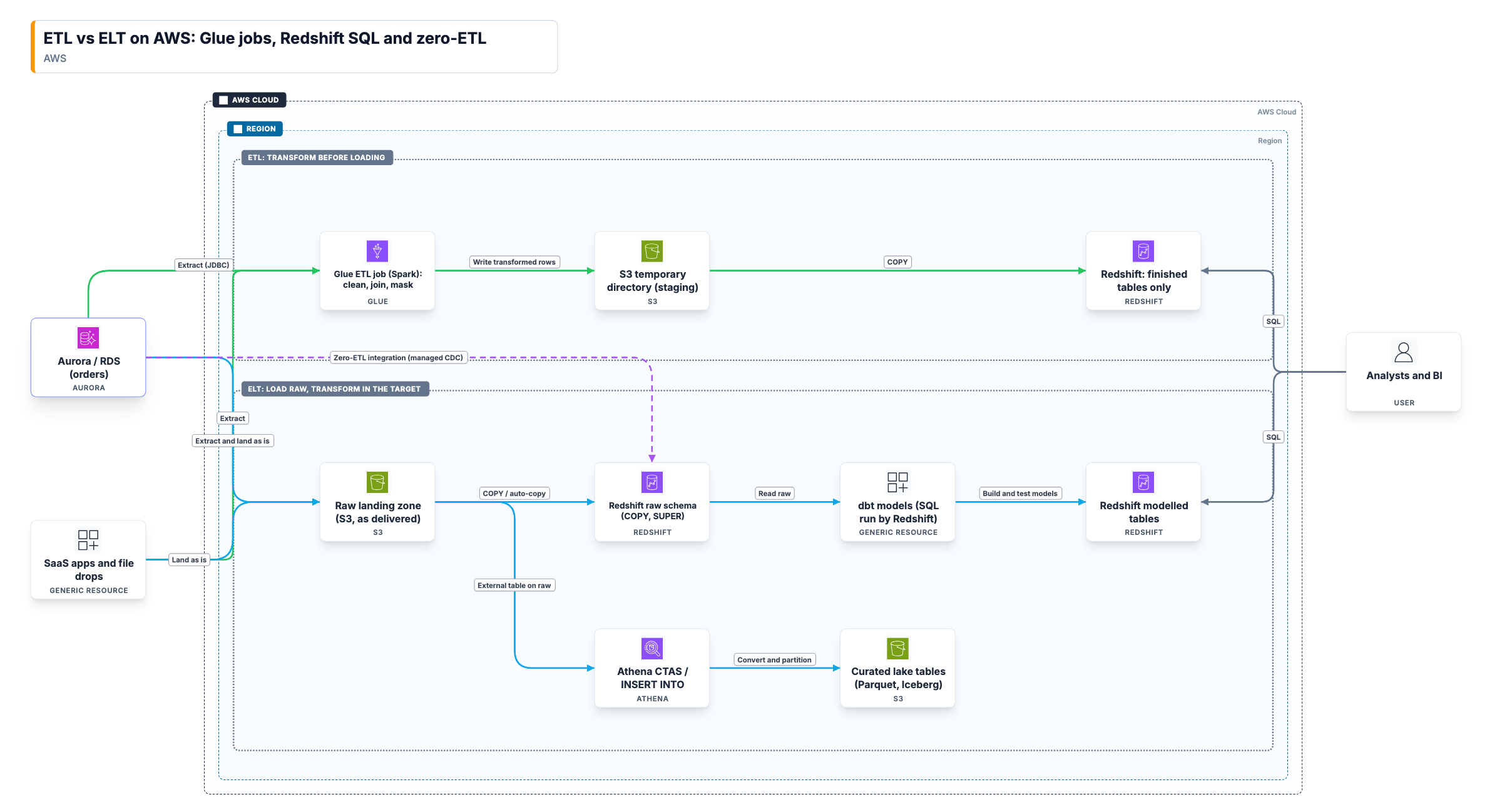 AWSETL vs ELT on AWS: Glue jobs, Redshift SQL and zero-ETLETL vs ELT on AWS, drawn side by side: Glue Spark jobs that transform before loading, raw loads transformed in Redshift or with Athena, and where zero-ETL fits.
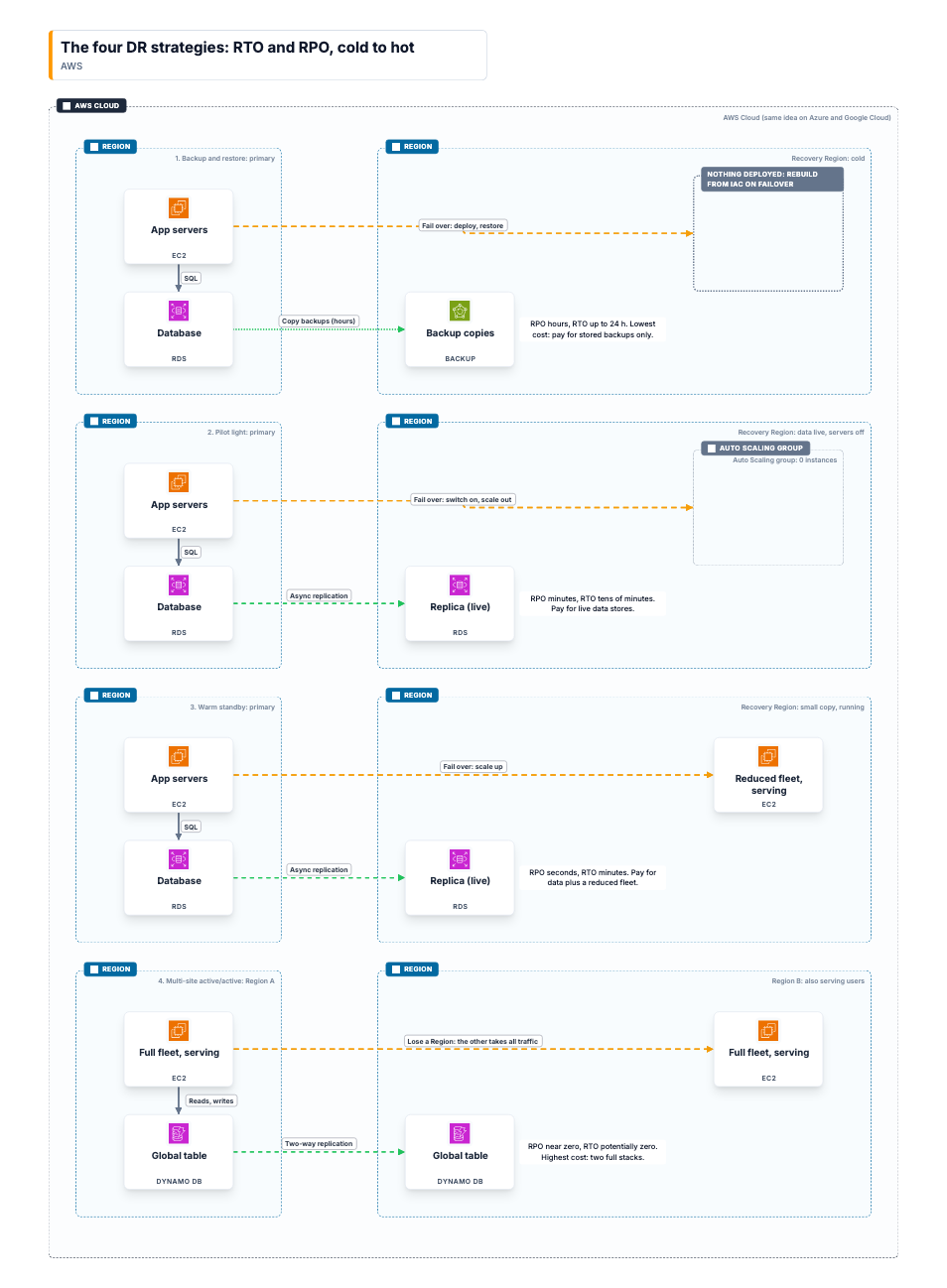 AWS · Azure · Google CloudThe four DR strategies: RTO and RPO, cold to hotWhat RTO and RPO mean, with a worked example, and the four disaster recovery strategies from backup and restore to active/active: what runs, what it costs, and how to choose.
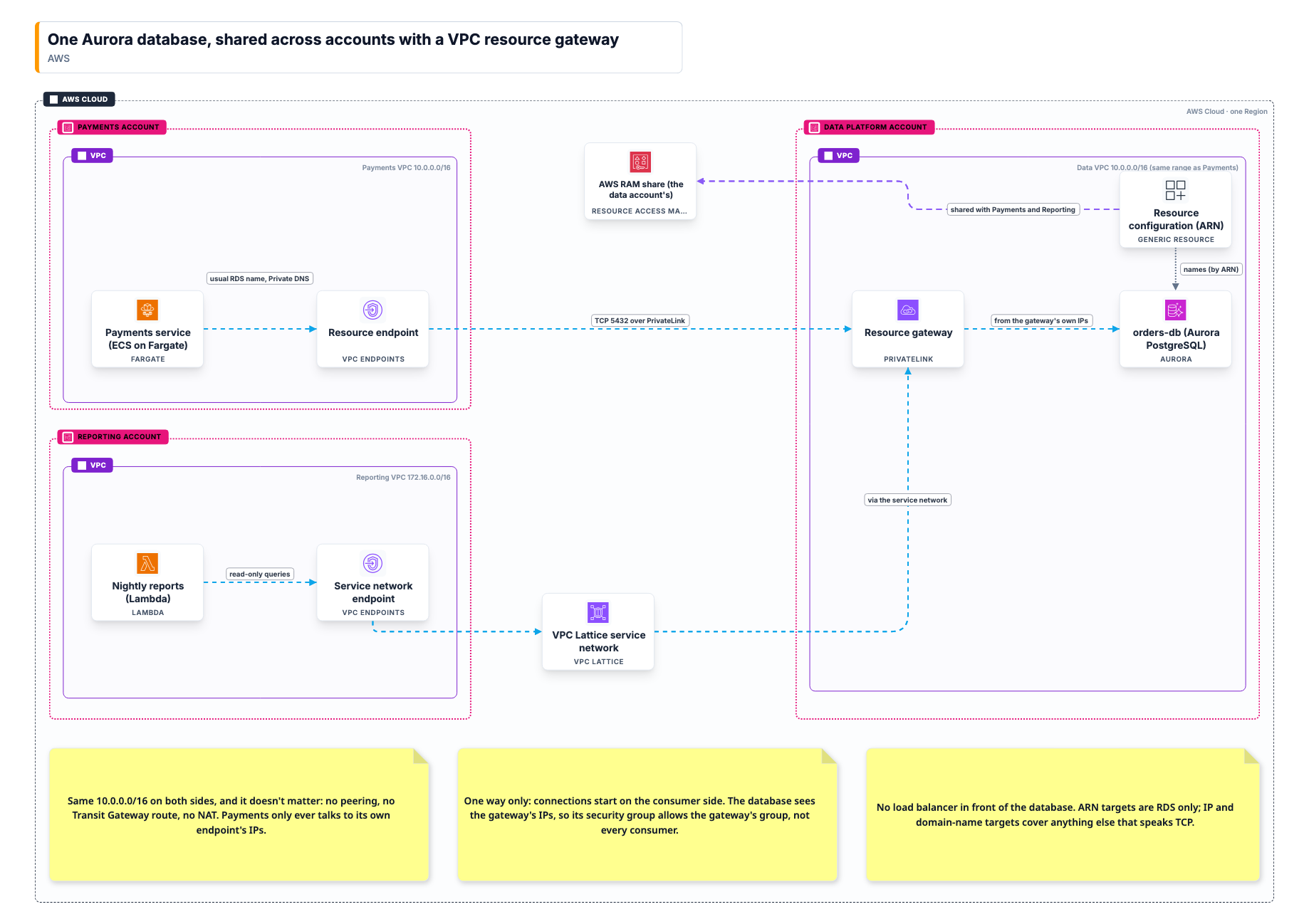 AWSOne Aurora database, shared across accounts with a VPC resource gatewayOne Aurora database reached from two AWS accounts, without VPC peering, a Transit Gateway or a load balancer: how resource gateways, resource configurations and resource endpoints fit together, even with overlapping CIDRs.