One Aurora database, shared across accounts with a VPC resource gateway
One Aurora database reached from two AWS accounts, without VPC peering, a Transit Gateway or a load balancer: how resource gateways, resource configurations and resource endpoints fit together, even with overlapping CIDRs.
Opens a copy in the editor, in a new tab, ready to change. No account needed.
What’s in this diagram
services and parts
- Payments service (ECS on Fargate)
- Resource endpoint
- Nightly reports (Lambda)
- Service network endpoint
- VPC Lattice service network
- Resource gateway
- orders-db (Aurora PostgreSQL)
- Resource configuration (ARN)
- AWS RAM share (the data account's)
groups
- AWS Cloud · one Region
- Payments account
- Payments VPC 10.0.0.0/16
- Reporting account
- Reporting VPC 172.16.0.0/16
- Data platform account
- Data VPC 10.0.0.0/16 (same range as Payments)
Key points
- A resource gateway is a set of network interfaces in the provider's VPC: the way in. A resource configuration says which resource behind it is shared, on which ports.
- Consumers reach it through a resource VPC endpoint, or through a VPC Lattice service network. Overlapping CIDRs don't matter, because the consumer only talks to its own endpoint.
- For Amazon RDS, an ARN-type resource configuration keeps the database's usual DNS names working on the consumer side with Private DNS.
- It is one-way and TCP-only: connections start from the consumer, and the database sees the gateway's IP addresses.
The whole story, step by step: Share an RDS database across VPCs with a PrivateLink resource gateway.
More diagrams
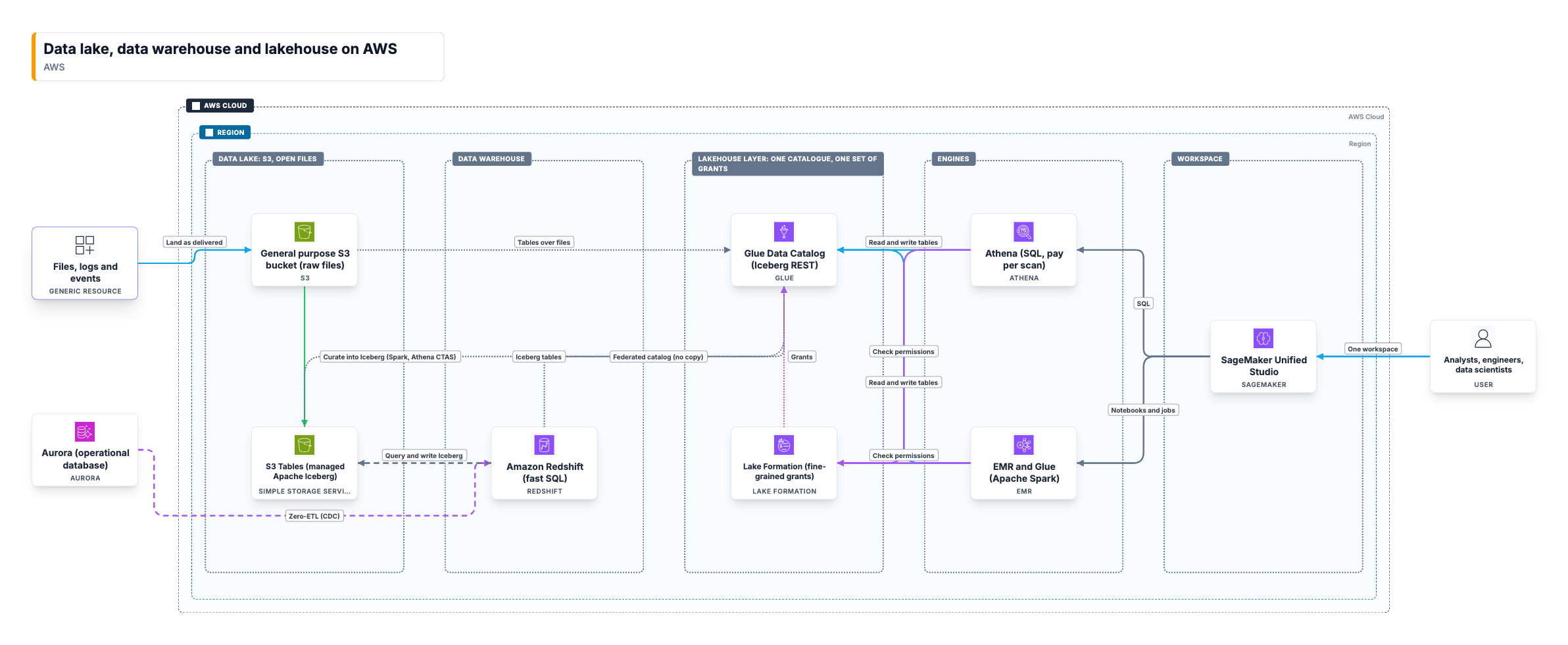 AWSData lake, data warehouse and lakehouse on AWSS3, Glue and Athena vs Amazon Redshift vs Apache Iceberg tables under one catalogue: what each is on AWS, where each fits in one diagram, and which to start with.
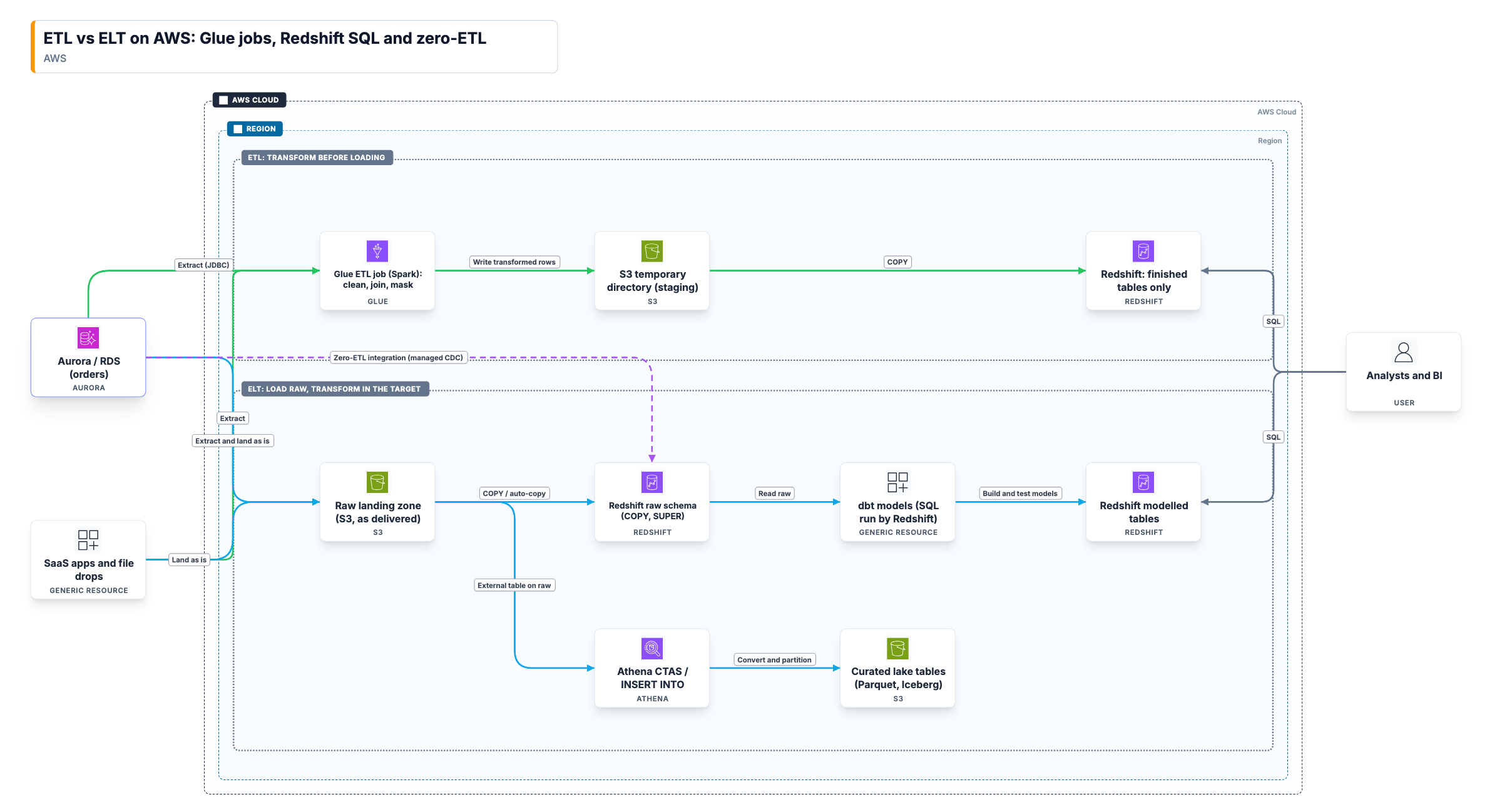 AWSETL vs ELT on AWS: Glue jobs, Redshift SQL and zero-ETLETL vs ELT on AWS, drawn side by side: Glue Spark jobs that transform before loading, raw loads transformed in Redshift or with Athena, and where zero-ETL fits.
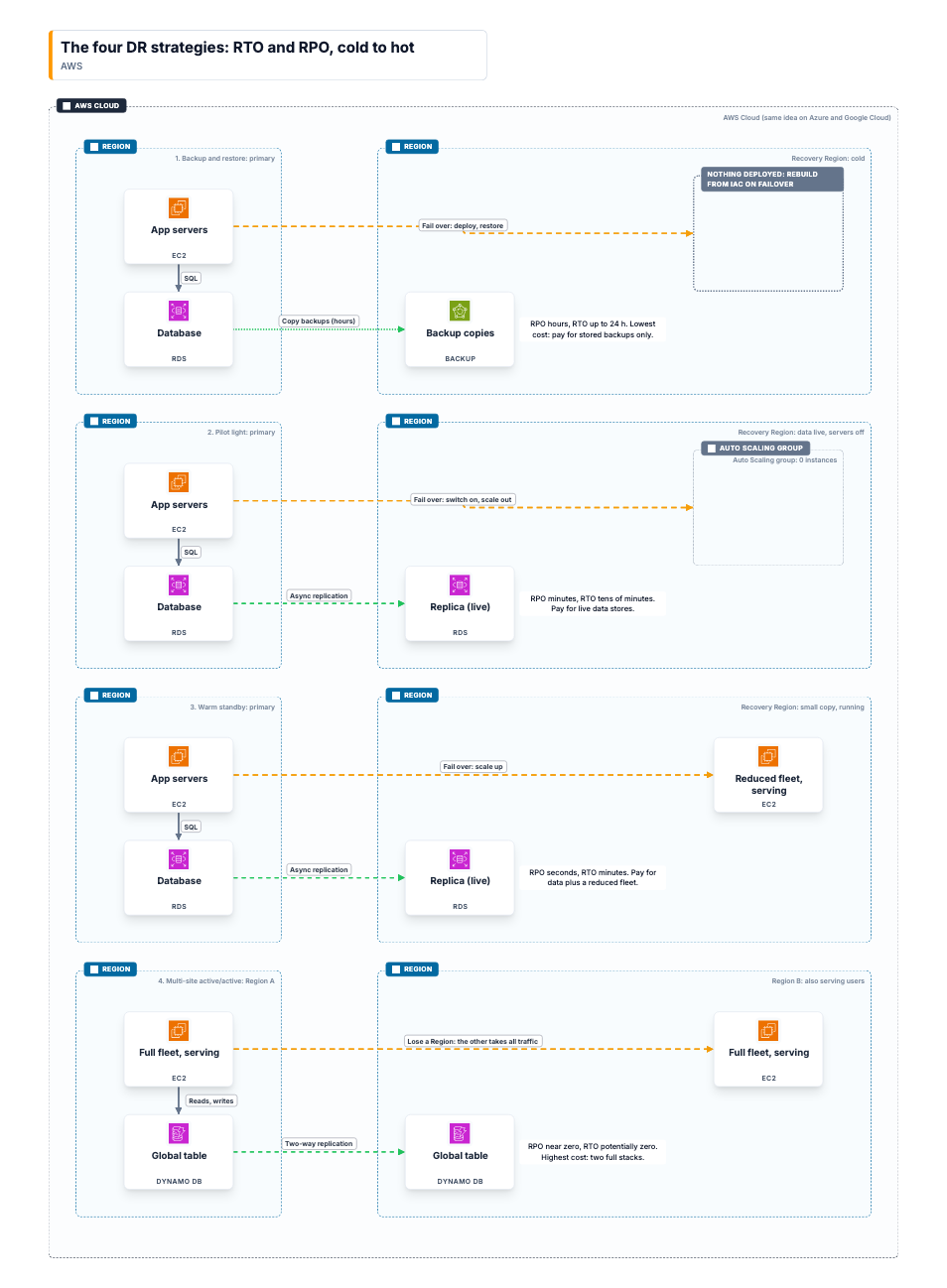 AWS · Azure · Google CloudThe four DR strategies: RTO and RPO, cold to hotWhat RTO and RPO mean, with a worked example, and the four disaster recovery strategies from backup and restore to active/active: what runs, what it costs, and how to choose.