Event-driven invoice pipeline on AWS (one Regional cell)
How an event-driven pipeline on AWS tracks every invoice through four stages with API Gateway, EventBridge, SNS, SQS and Lambda, and what to watch: duplicates, quotas and stuck messages.
Opens a copy in the editor, in a new tab, ready to change. No account needed.
What’s in this diagram
services and parts
- Finance systems (event producers)
- AWS WAF
- REST API: one path per stage
- Custom event bus + archive
- invoice-ingestion topic
- FIFO queue
- Dead-letter queue
- Ingestion processor
- invoice-posting topic
- Posting processor
- Long-running work (Fargate)
- Event timeline (Timestream)
- Business dashboards (QuickSight)
- Alarms, logs, X-Ray traces
groups
- AWS Cloud
- Regional cell
- Stage partition: ingestion
- Stage partition: posting (reconciliation and authorisation repeat this lane)
Key points
- Split the process into stages and give each stage its own lane: topic, queue, dead-letter queue and consumer.
- Route centrally on one event bus, and keep an archive so you can replay.
- Every queue needs a dead-letter queue and an alarm on it; a stuck invoice is the failure that matters.
- Plan for duplicates. Retries happen at several layers, so consumers must be idempotent.
The whole story, step by step: AWS event-driven architecture: a resilient invoice pipeline.
More diagrams
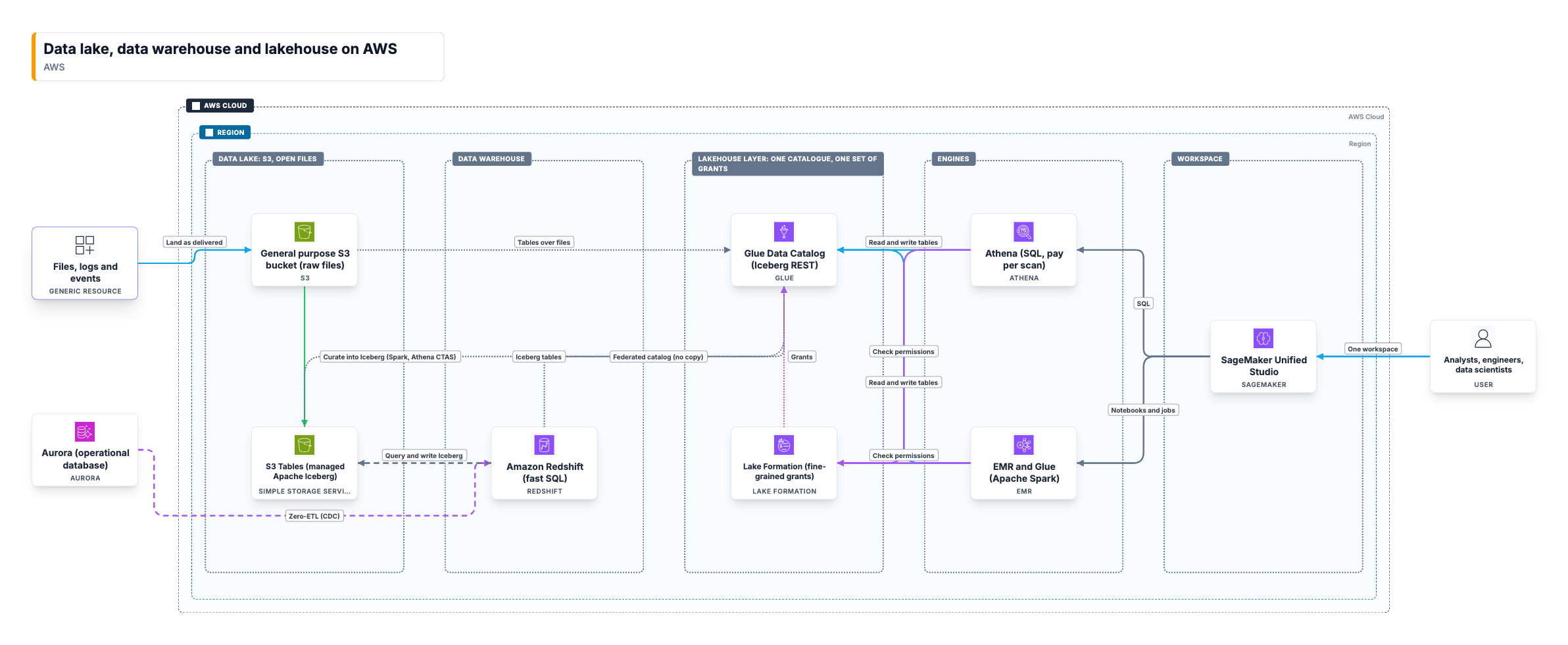 AWSData lake, data warehouse and lakehouse on AWSS3, Glue and Athena vs Amazon Redshift vs Apache Iceberg tables under one catalogue: what each is on AWS, where each fits in one diagram, and which to start with.
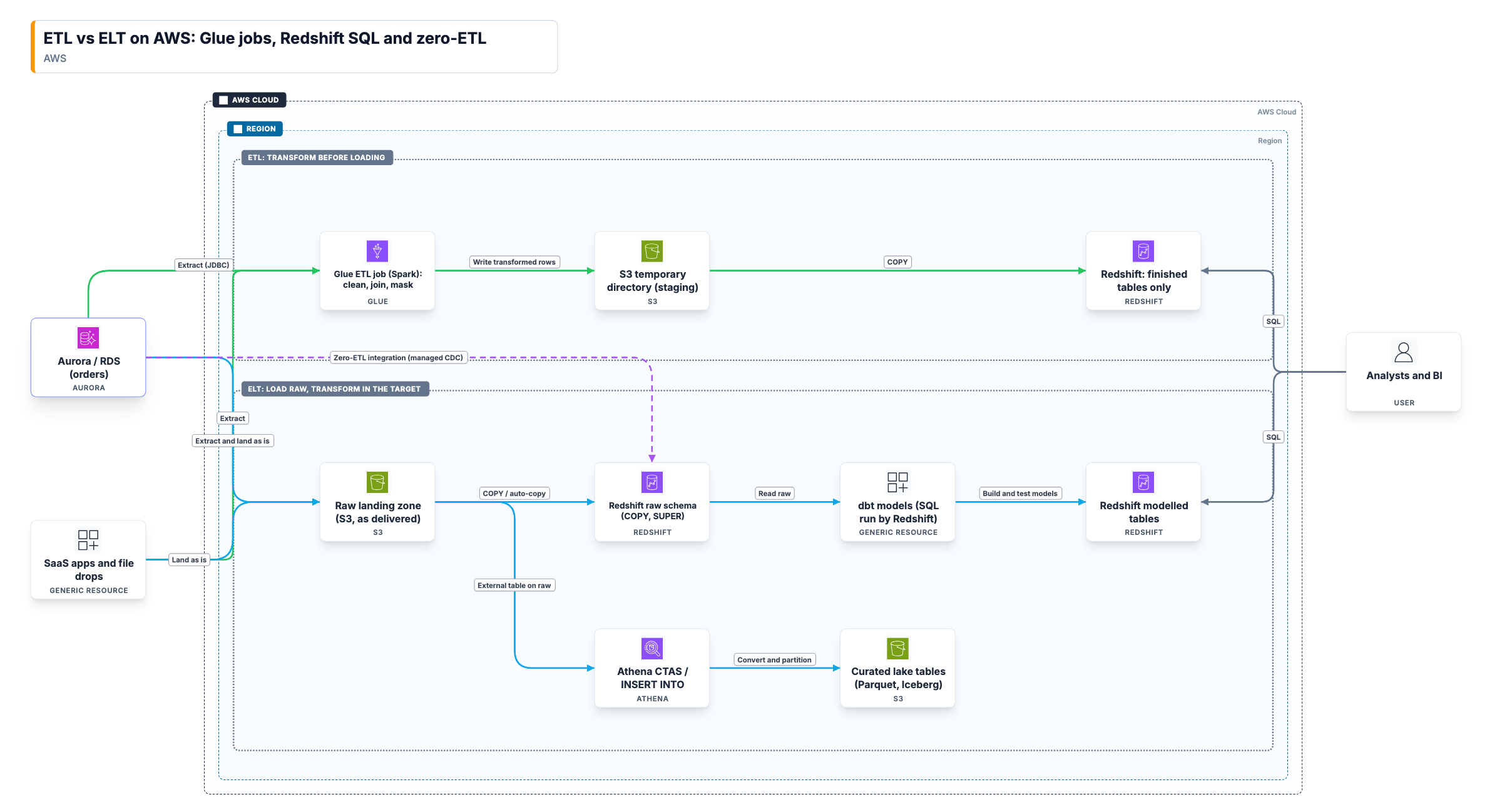 AWSETL vs ELT on AWS: Glue jobs, Redshift SQL and zero-ETLETL vs ELT on AWS, drawn side by side: Glue Spark jobs that transform before loading, raw loads transformed in Redshift or with Athena, and where zero-ETL fits.
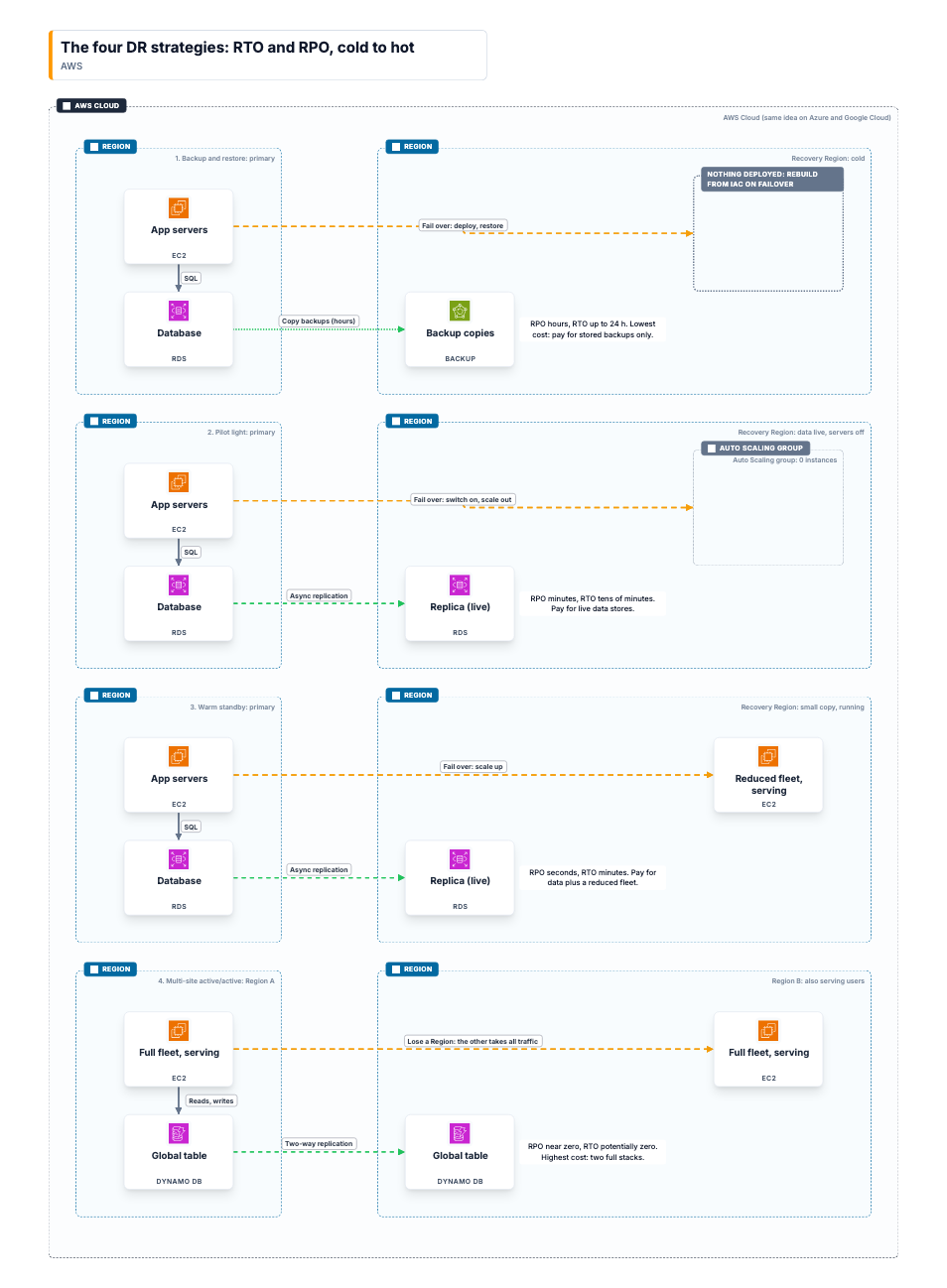 AWS · Azure · Google CloudThe four DR strategies: RTO and RPO, cold to hotWhat RTO and RPO mean, with a worked example, and the four disaster recovery strategies from backup and restore to active/active: what runs, what it costs, and how to choose.