AWS · DATA AND ANALYTICS · ARCHITECTURE PATTERNS
ETL vs ELT on AWS: Glue jobs, Redshift SQL and zero-ETL
- ETL transforms on a separate engine before loading. ELT loads raw data first and transforms it inside the warehouse or lake.
- On AWS, ETL usually means a Glue Spark job. ELT means SQL in Redshift, often organised with dbt, or Athena CTAS on the lake.
- ELT keeps the raw copy, so you can rebuild when the logic changes. ETL can keep personal or messy data out of the target altogether.
- Zero-ETL replaces the extract and load, not the transform. It is ELT with the pipeline run for you.
Most ETL vs ELT AWS comparisons stop at the definitions. The useful question is where your transformation code runs, and what that does to cost, freshness and control. This post draws both flows on AWS side by side: AWS Glue jobs that transform before loading, and raw loads into Amazon S3 or Amazon Redshift that are transformed where they land. Then it says when each wins, and where zero-ETL fits.
The two patterns
ETL is extract, transform, load. Data leaves the source, is cleaned, joined and reshaped on its own processing engine, and only finished tables reach the target. ELT is extract, load, transform. Raw data lands in the target first, and the target's own engine does the reshaping, usually in SQL. AWS's own comparison calls ELT the standard choice for modern analytics, but ETL still earns its place.
The design
Read the diagram left to right: the same two sources feed an ETL lane above and an ELT lane below (open the diagram).
ETL with AWS Glue
A Glue job runs on Glue's serverless Apache Spark engine; Ray and plain Python shell jobs exist too. It reads the source over JDBC or a connector, cleans and conforms the data in memory, and writes only the result. When the target is Redshift, Glue stages the rows in an S3 temporary directory and issues a COPY. The warehouse never sees the raw shape. Glue Studio can generate the PySpark script from a visual job, which is a fair start but no substitute for tests.
ELT into Redshift
Land the data as delivered in an S3 raw zone, then load it into a raw schema in Redshift. COPY is the efficient way in: it reads many files in parallel across the cluster's nodes. Auto-copy runs it whenever a new file appears on a watched path and keeps track of what it has loaded. From there, SQL builds the modelled tables. dbt is the common way to keep that SQL in version control as tested models; it compiles them and Redshift runs them. JSON whose shape keeps changing can sit in a SUPER column, which takes a new attribute without a schema change.
ELT on the lake
If the target is S3 rather than a warehouse, Amazon Athena does the transform. One CREATE TABLE AS SELECT turns raw CSV or JSON into partitioned, compressed Parquet or an Apache Iceberg table, and INSERT INTO adds each new batch, up to 100 partitions per statement. In AWS's worked example, the same query scanned 11.35 GB on the raw CSV and 68 MB after conversion. Glue or Amazon EMR Spark jobs that read the raw zone and write a curated zone are ELT too: the load came first. dbt has an Athena adapter as well.
Where zero-ETL fits
Zero-ETL integrations replicate a source into Redshift, keep it in step as rows change, and recover from errors themselves. Supported sources include Aurora MySQL and PostgreSQL, RDS for MySQL, PostgreSQL and Oracle, DynamoDB, self-managed databases, and applications such as Salesforce, SAP, ServiceNow and Zendesk. Some sources can also land in S3 Tables through the lakehouse architecture of Amazon SageMaker. There is no pipeline to run, but the data arrives in the source's shape and you still model it in the target. That is ELT with a managed extract and load: the dashed purple rail.
When each wins
- Cost. ETL pays for a separate engine on every run, then stores only the result. ELT spends warehouse or query compute on transforms and stores both raw and modelled copies. On a shared Redshift, heavy models compete with analysts for the same capacity.
- Latency. ELT makes data visible sooner: load first, model on a schedule. Zero-ETL brings operational data in near real time. ETL puts a processing step before anything appears.
- Governance. ETL can mask or drop personal data before it is stored anywhere you query. ELT puts raw data in the target, so the raw schema needs tight grants, few readers and short retention.
- Schema drift. ELT copes better. The raw copy keeps every column and the model decides what to use. A Glue job with a fixed mapping drops a new field or fails, and by the time you notice, the source may have moved on.
- Changing logic. With ELT you rebuild modelled tables from raw. With pure ETL, history you did not keep is gone. That is why most Glue designs keep a raw zone anyway, and end up as a hybrid.
Our view
Default to ELT for analytics on AWS: land raw data in S3 and model it in Redshift or on the lake with SQL that lives in version control. Reach for a Glue Spark job where SQL is the wrong tool: heavy reshaping of nested data, data that must be masked before anyone may store it, or files too large or odd for the warehouse to read. Use zero-ETL wherever your source is supported and you would otherwise write a copy job.
How to draw it in archhy
- Place an AWS Cloud and a Region, then two dotted boundaries from the Draw drawer, one per pattern, stacked so the stages line up in columns.
- From the Services drawer, search the AWS pack for Glue, Redshift, Athena and Aurora, and add S3 buckets for staging, raw and curated data.
- Keep the transform step in the same column in both lanes, so the eye sees it move from before the load to after it.
- Colour the rails by lane: green for ETL, blue for ELT, dashed purple for zero-ETL.
- Download a PNG for the design review.
More in the Data on AWS series: the hub, AWS data lake architecture, then data lake vs data warehouse vs lakehouse, AWS Glue in depth, DMS change data capture vs zero-ETL and S3 zones, formats and Iceberg.
Frequently asked questions
What is the difference between ETL and ELT on AWS?
ETL transforms data on a separate engine, usually an AWS Glue Spark job, before loading finished tables. ELT loads raw data into Amazon Redshift or S3 first and transforms it there with SQL.
Is AWS Glue ETL or ELT?
Either. A Glue job that reads a source and writes finished tables is ETL. One that reads a raw zone already in S3 and writes curated tables is the transform step of ELT.
Does zero-ETL mean no transformation?
No. It removes the pipeline that copies the data. Rows arrive in the source's shape, and you still model them in the target.
Can I use dbt on AWS?
Yes. dbt has adapters for Amazon Redshift and Amazon Athena; it compiles your models and the warehouse or Athena runs the SQL.
based on Discussed from AWS's What's the difference between ETL and ELT?, with current details checked in the Amazon Redshift zero-ETL guide, the AWS Glue Redshift connection guide and the Athena guide's Use CTAS and INSERT INTO for ETL (November 2026). The diagram and the commentary are archhy's own.
more on aws
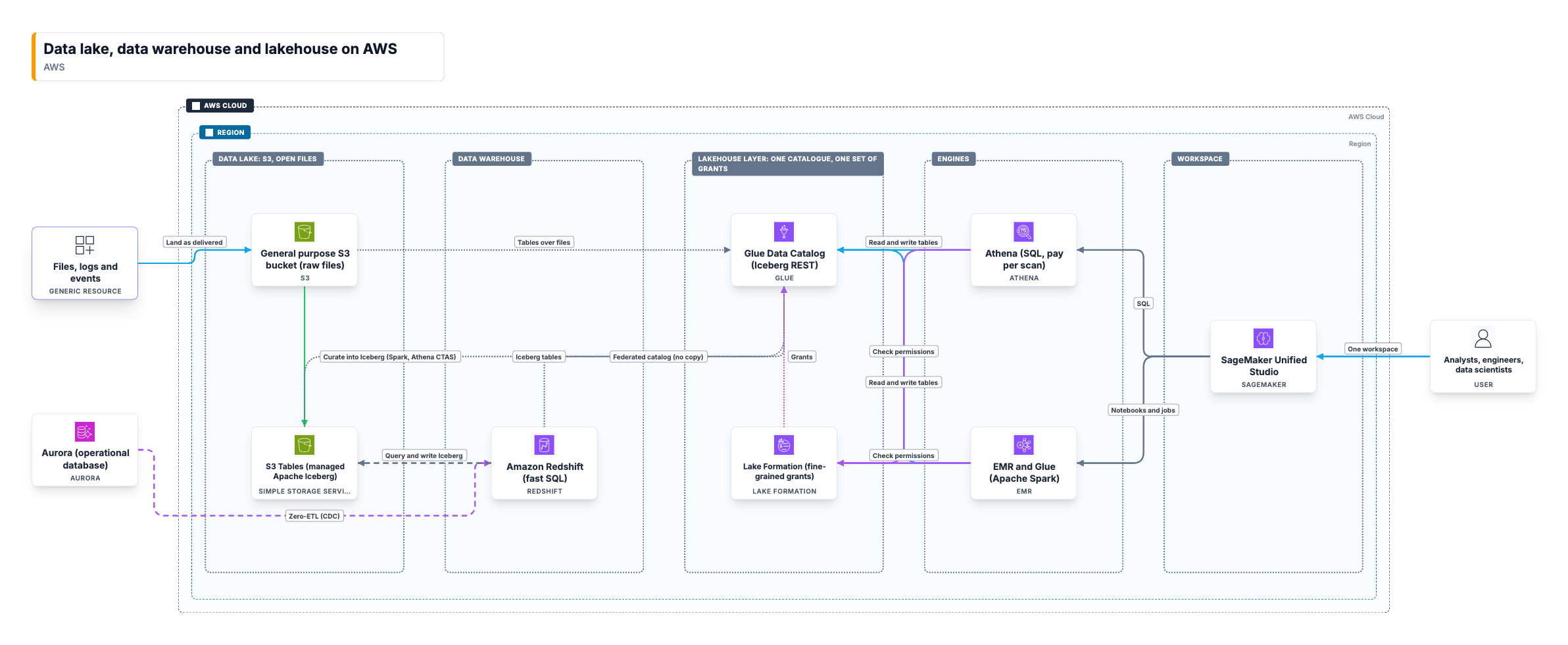 Data lake vs data warehouse vs lakehouse on AWSS3, Glue and Athena vs Amazon Redshift vs Apache Iceberg tables under one catalogue: what each is on AWS, where each fits in one diagram, and which to start with.
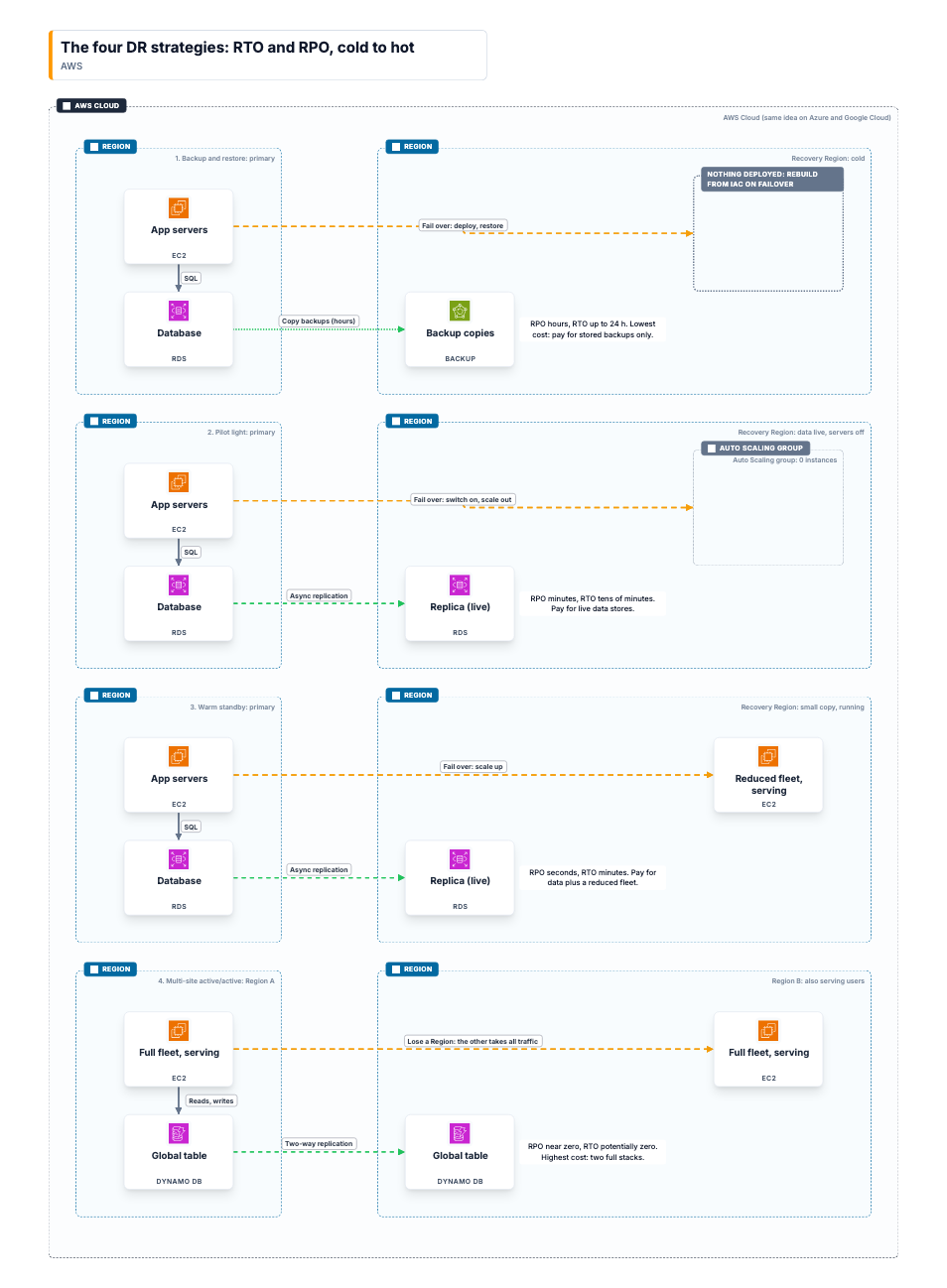 RTO and RPO explained: the four disaster recovery strategiesWhat RTO and RPO mean, with a worked example, and the four disaster recovery strategies from backup and restore to active/active: what runs, what it costs, and how to choose.
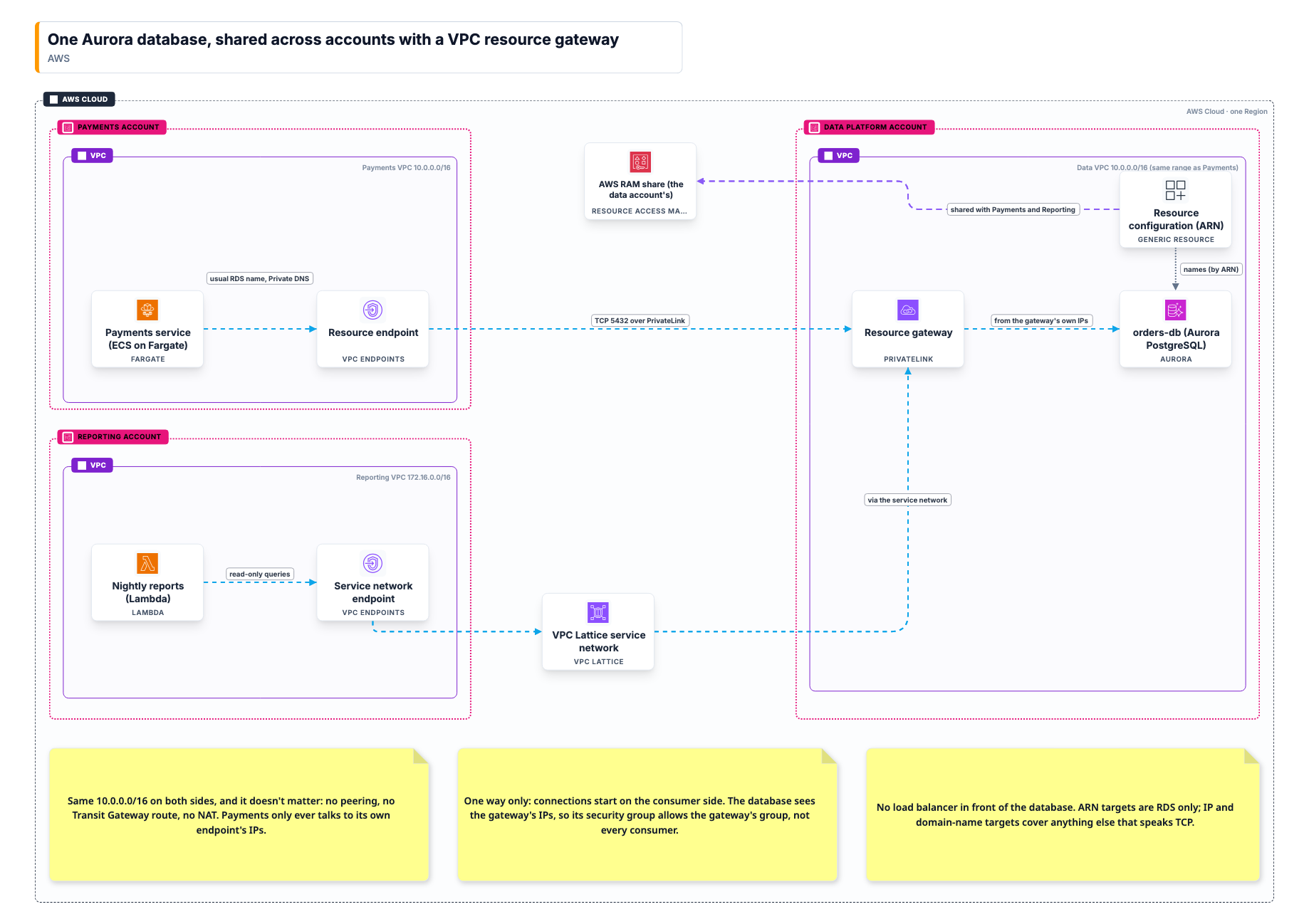 Share an RDS database across VPCs with a PrivateLink resource gatewayOne Aurora database reached from two AWS accounts, without VPC peering, a Transit Gateway or a load balancer: how resource gateways, resource configurations and resource endpoints fit together, even with overlapping CIDRs.